
Why we’re rediscovering the simple rituals that make connection possible.
We have more ways to communicate than any generation before us. We can reach someone instantly, maintain friendships across continents, and stay connected without ever leaving our homes. And yet, something is missing.
Despite all this connectivity, we’re spending less time together in person. Loneliness and social isolation have become serious enough concerns to prompt a U.S. Surgeon General’s advisory. We’ve made communication almost effortless, but meaningful relationships still require something surprisingly old-fashioned: spending time together, repeatedly.
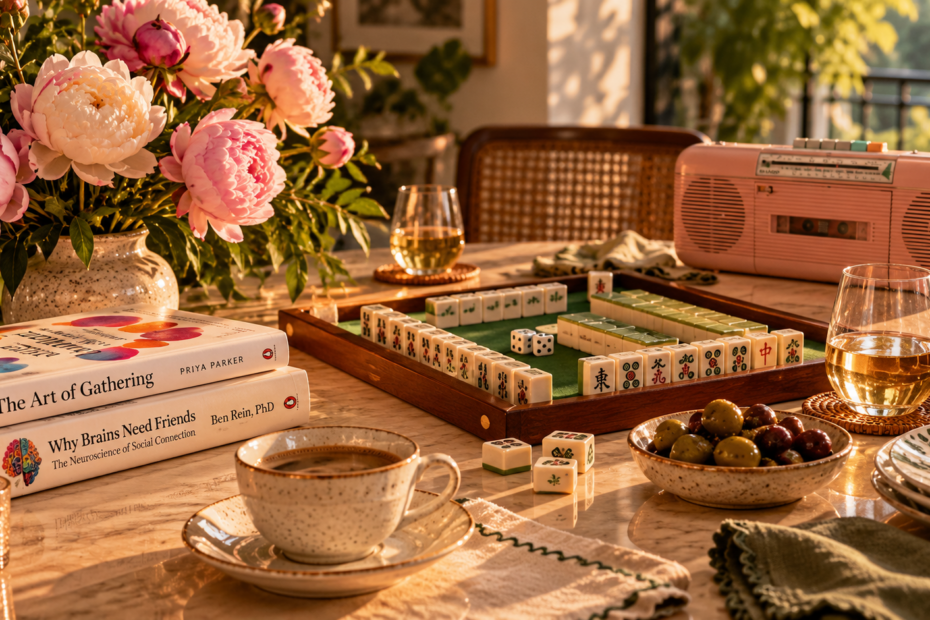
Lately, I’ve been noticing something that makes me wonder whether we’re beginning to recognize what we’ve lost. Mahjong tables are filling up. Knitting circles, walking clubs, book clubs, and supper clubs are attracting people looking for something beyond another online interaction. Even the simple dinner party seems to be making a comeback. Perhaps we’re not simply rediscovering old hobbies, but the importance of having a reason to be together.
More than twenty-five years ago, political scientist Robert Putnam described a troubling trend in Bowling Alone. Americans hadn’t necessarily stopped bowling. What had declined was participation in bowling leagues. You could still bowl. What disappeared was the league.
Bowling leagues, neighborhood associations, religious organizations, and clubs once provided a kind of social infrastructure. They brought people together regularly without anyone having to organize each encounter. The occasion already existed, creating familiarity and relationships that extended beyond the activity itself. Putnam documented this decline long before smartphones and social media became part of everyday life.
Then came the pandemic, interrupting many of the routines that still brought us together. We learned to work, celebrate, exercise, and maintain relationships from home. Technology made much of that possible, but I wonder whether something else happened along the way. As isolation became familiar, perhaps some of us also became comfortable with it. Hosting felt complicated. Making small talk, dressing up (never mind wearing heels again!), accepting invitations, or simply getting ourselves out the door required effort. What had once been part of everyday life increasingly became something we had to organize.
We haven’t necessarily lost the desire to connect. We’ve lost many of the excuses to gather.
For me, the renewed interest in analog experiences is particularly fascinating. Mahjong, knitting, embroidery, padel, ceramics, puzzles, walking , and cooking, invite us to step away from our individual screens and participate in something together. This isn’t necessarily nostalgia or a rejection of technology. But convenience, efficiency, and constant connectivity don’t fulfill every human need.
Analog experiences are often slower and less convenient. They require us to be somewhere, at a particular time, with other people. Perhaps that’s part of their appeal. Working with our hands, concentrating on a shared activity, or sitting around a table gives our attention somewhere to settle. The benefit may not simply be what we disconnect from, but what we reconnect with.
Around 2019, as part of the Agrupación de Damas Sefaradí in Bogotá, we began exploring ways to bring older community members together more easily. We decided to start a knitting group.
Every Monday at 2:00 p.m., we opened a space with yarn, coffee, tea, sambusaks, and cake. No registration, no RSVP, no complicated program. Whoever wanted to come could simply show up. We call the group Las Tejedoras.
To give the activity additional meaning, we decided that whatever the women knitted would be donated to patients undergoing chemotherapy at Colombia’s Instituto Nacional de Cancerología. Week after week, more women began coming. They knitted, talked, laughed, and got to know one another. Over the years, a beautiful tight community developed, and hundreds of scarves and beanies were donated.
The donations gave the work meaning, but something equally meaningful was happening around the knitting table: relationships were forming. What struck me was how little we had needed to do. We provided a space, a predictable time, something to do, and a reason to come. The women did the rest.
Lately, I’ve been noticing a similar phenomenon with mahjong.
In Miami, Aspen, New York, and Bogotá, including my community where “Las Tejedoras” began, mahjong seems to be everywhere. People are gathering around mahjong tables.
WhatsApp groups buzz with some variation of the same question: Who wants to play? Someone has a table, someone has a few hours, and before long, four people are sitting together. It’s not just my social circles. Eventbrite data reported by Axios showed a 179% increase in U.S. mahjong events listed on the platform between 2023 and 2024.
What interests me isn’t simply the popularity of the game, but how effortlessly it creates a social opportunity. Nobody has to say, “I’m feeling lonely. Would someone like to spend the afternoon with me?” They can simply ask, “Who wants to play mahjong?” The game provides the invitation. The connection happens around it.
Something similar is happening around dinner tables. In her essay Just Host the Damn Dinner Party, writer Nisha Chittal argues against allowing the pressure to entertain perfectly to prevent us from inviting people into our homes. An imperfect home or a simple meal may offer something a carefully orchestrated event cannot: the freedom to relax and let others into our ordinary lives.
I think part of the reason these activities work is that they remove the pressure to connect. As adults, initiating social contact can feel surprisingly complicated. Asking someone to spend an afternoon together may feel vulnerable. But asking someone to join a game, take a walk, or come knit on Monday afternoon feels different.
The activity gives the invitation a purpose. And once people arrive, it provides what I think of as structured unstructured time: enough structure to bring people together, but enough freedom for relationships to develop naturally. You don’t have to sustain a meaningful conversation for three hours. Conversation happens alongside the activity rather than becoming the activity itself. People share stories, gossip, laugh, or sometimes barely talk at all.
There’s something valuable about this kind of incidental intimacy. We often associate meaningful relationships with deep conversations or extraordinary experiences, but much of friendship develops through ordinary moments: sitting beside someone, seeing them again the following week, and gradually becoming familiar with the details of their life.
One gathering can be enjoyable, but a recurring gathering creates continuity. The person you meet at a knitting circle becomes someone you recognize. After several weeks, you begin asking about her children or her upcoming trip. Eventually, you notice when she’s absent. Socializing creates encounters. Rituals create continuity. Continuity creates the conditions for belonging.
Sociologist Ray Oldenburg introduced the concept of third places: informal gathering spaces outside home and work where people regularly encounter familiar faces and develop a sense of community. But the physical place doesn’t always have to be permanent. A mahjong group can move between homes, a knitting circle can gather wherever there’s a table, and a walking group can meet in different neighborhoods. Sometimes the recurring ritual itself becomes the social infrastructure.
What matters is the consistency of the gathering and the relationships that develop around it. Simply bringing people into the same room doesn’t guarantee belonging, but returning and accumulating ordinary experiences together creates the conditions for it. A full social calendar is not necessarily the same thing as a socially connected life.
Perhaps one of the questions this analog revival raises is whether we’ve made ordinary socializing unnecessarily complicated. Calendars fill weeks in advance. Dinner invitations can feel like productions. Hosting comes with expectations about food, presentation, and preparation. When gathering feels like work, it’s easy to postpone it until the house is ready or life becomes less busy.
But what if meaningful social experiences require much less than we imagine? A weekly walk, an informal dinner, a standing game, a familiar table, an open invitation. Las Tejedoras taught me that people often don’t need elaborate programming to connect. They need an accessible opportunity, a reason to show up, and the freedom to return. We may not need more opportunities to communicate. We may need easier ways to gather.
As I think about adults rediscovering the pleasure of simple, recurring gatherings, I can’t help wondering what this means for the next generation. A 2019 study in the Journal of Social and Personal Relationships found that American high school seniors in 2016 spent approximately one hour less per day in face-to-face social activities than their counterparts in the late 1980s.
We often discuss these changes in the context of smartphones and screen time. But perhaps we should also ask what opportunities are available to children when they put their phones away. Do they have places to gather spontaneously? Time with friends without an adult directing every moment? Opportunities to play, disagree, negotiate, get bored, and figure out what to do next?
Many children have full schedules of school, sports, lessons, and organized activities. These experiences are valuable, but they don’t always replace informal social time. A busy childhood is not necessarily a socially connected childhood. Rather than adding another activity, perhaps we can make room for spontaneous play, welcome friends into our homes, and support age-appropriate independence. Instead of focusing exclusively on getting children off their screens, we might ask how to make the world beyond those screens more inviting.
Much of belonging develops through ordinary moments: showing up, recognizing familiar faces, doing things together, and coming back next week. Perhaps the return to analog life is reminding us of something we’ve always known but gradually made harder to practice.
Human connection doesn’t always need a special occasion. Sometimes it simply needs a place, a rhythm, and an open invitation.
Maybe the most meaningful thing we can do is make gathering ordinary again.